The Core Problem: Sub-20nm DRAM Scaling & Bit Flips
As DRAM manufacturing process nodes have scaled below 20nm, storage capacitors have shrunk and wordlines are packed in extreme physical proximity. Repeatedly toggling (activating and precharging) a single DRAM wordline—an aggressor row—causes electromagnetic interference and accelerated charge leakage in adjacent victim rows. If the activation count exceeds the critical RowHammer threshold (TRH), the charge stored in victim capacitors degrades past the sense-amplifier detection margin, inducing unrecoverable bit flips.
Legacy mitigation strategies like Target Row Refresh (TRR) relied on sampling or probabilistic hardware tables inside the DRAM controller or DRAM die to guess which rows were being hammered. Modern exploit techniques easily bypassed TRR via "many-sided" or "feinting" activation patterns, forcing JEDEC to standardize hardware-level tracking directly inside the JESD79-5C DDR5 SDRAM specification.
1. The Death of TRR and the Rise of JEDEC PRAC
Traditional Target Row Refresh (TRR) operated strictly as a "black box" inside the DRAM chip. It sampled row activations probabilistically and fired counter-refreshes to neighboring rows during regular refresh windows. Because TRR counters were limited in size and completely hidden from the host system's memory controller, sophisticated access patterns (such as 16-sided hammering, cascaded feinting, and synchronization attacks) could easily overflow or desynchronize TRR tracking logic without ever triggering a victim refresh.
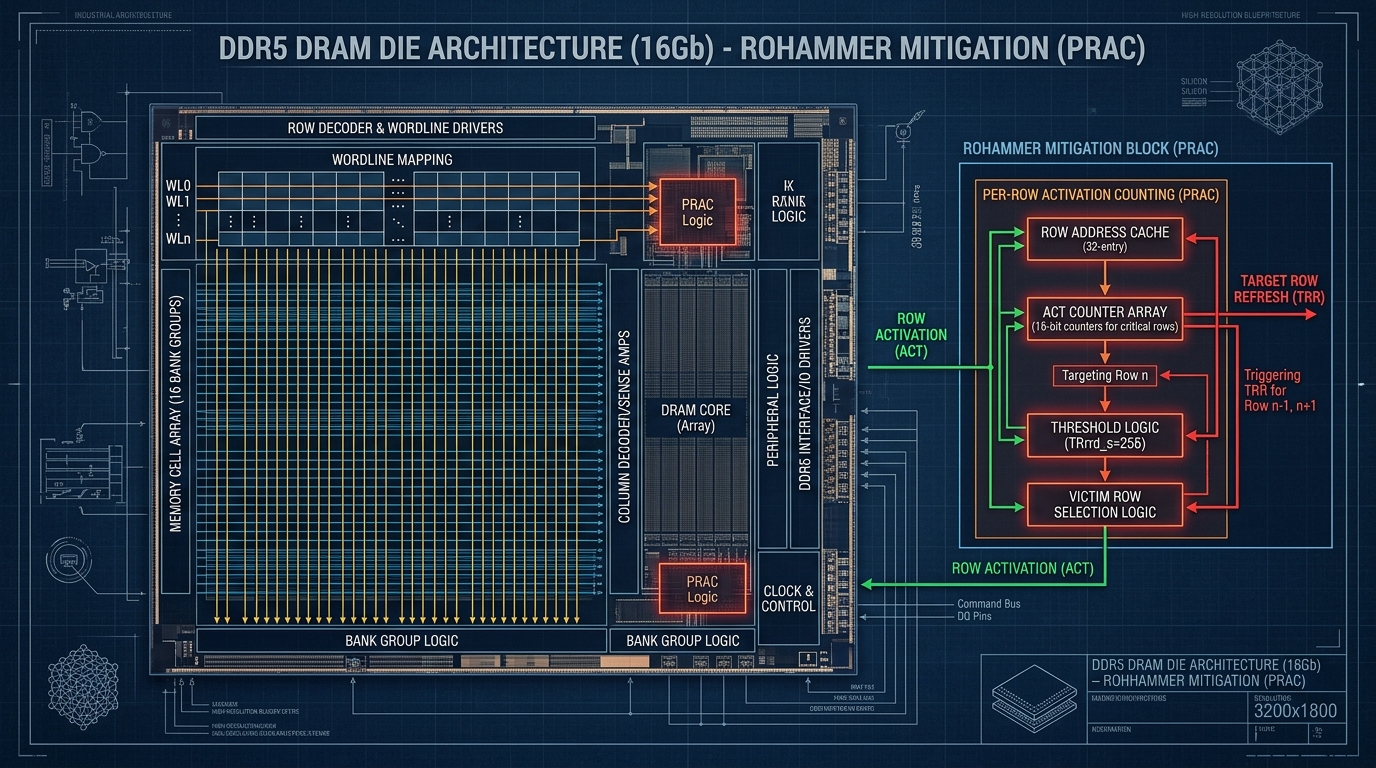
Per-Row Activation Counting (PRAC) completely replaces probabilistic sampling with exact, deterministic tracking by embedding counter metadata directly alongside every DRAM row inside the memory array. Under the JEDEC JESD79-5C standard, DRAM silicon no longer guesses which wordlines are under attack—every row tracks its own operational history.
2. Architectural Challenges & Recent Research Solutions
While PRAC closes the fundamental security hole of TRR, implementing precise counter updates at nanosecond speeds introduces severe hardware performance, timing, and queue management overheads:
Architectural Trade-off Matrix
| Feature / Dimension | Legacy TRR (DDR4) | Standard DDR5 PRAC (JESD79-5C) | Advanced PRAC (One-Hot / Dual-Threshold) |
|---|---|---|---|
| Tracking Granularity | Probabilistic sampling / small table | Deterministic (1 counter per row) | Deterministic (1 counter per row) |
| Hardware Overhead | Minimal (< 0.1% silicon area) | ~1–3% DRAM die area overhead | ~1–2% DRAM die area + modified sense amps |
| Performance Impact | < 0.5% slowdown | Up to 16.7% slowdown due to RMW (tUP) delay | < 0.3% slowdown (hides RMW latency) |
| Security Guarantee | ✕ Broken (Bypassed via multi-sided hammering) | ▲ High (Requires tuned ABO thresholding) | ✓ Provably Secure (Resistant to arbitrary feinting patterns) |
| System Co-design | Isolated to DRAM die | Requires ALERT_n host-DRAM protocol | Requires ALERT_n + tuned memory controller scheduling |