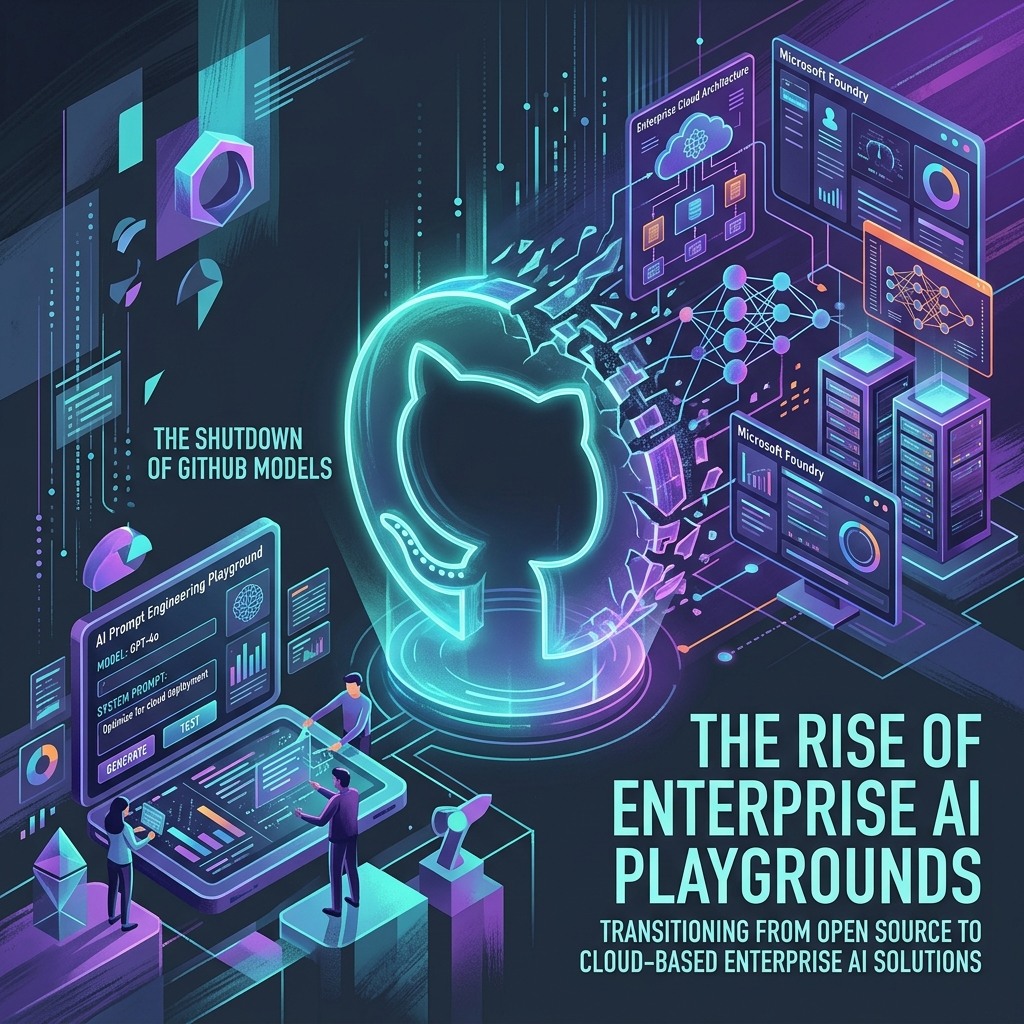
You could spin up a playground, test a frontier model, compare outputs, and ship a working AI feature in an afternoon. On July 30, 2026, that door slammed shut.
GitHub Models is dead. Fully retired. The playground, the model catalog, the inference API, the bring-your-own-key endpoints — all of it, gone. Not just for new customers. For everyone. Including the teams that had built CI pipelines, hackathon prototypes, and internal tools on top of it.
And in its place? Microsoft is pointing everyone to Microsoft Foundry — its sprawling, enterprise-grade AI platform that now houses one of the most ambitious playground ecosystems in the industry. But Microsoft isn't alone. The AI playground game in 2026 is crowded, fragmented, and increasingly cutthroat. Here's what happened, why it matters, and who's actually worth your time.
The Timeline: How GitHub Models Died
The shutdown wasn't sudden. It was a three-act play, and anyone paying attention saw the ending coming:
| Date | Event & Operational Impact |
|---|---|
| June 16, 2026 | GitHub Models closed to new customers. If your org hadn't used it before, you couldn't start. |
| July 1, 2026 | Full retirement announced for July 30. Brownouts scheduled for July 16 and 23 — temporary service interruptions as a warning shot. |
| July 16 & 23, 2026 | Brownouts hit. GitHub Models requests temporarily returned errors to force pipeline decoupling. |
| July 30, 2026 | Lights out. Playground, model catalog, inference API, BYOK — all removed. The UI gone. Endpoints returning HTTP 404/410 errors. |
No grandfathering. No extended sunset. Just a date and a redirect.
Why GitHub Pulled the Plug
GitHub Models launched in 2025 as an experiment: what if developers could test and call frontier models without leaving GitHub? It was genuinely useful — especially for prototyping in Codespaces and running model evaluations in GitHub Actions. The authentication model was the killer feature: your GitHub token was your API key. No separate billing. No provider accounts.
But it was also, in retrospect, a product without a business model. It was free. It cannibalized Microsoft's paid Azure AI services. And it sat awkwardly between two much bigger strategic bets:
- GitHub Copilot — the cash cow, now supporting a range of models behind a subscription
- Microsoft Foundry — the enterprise AI platform that Microsoft wants to be the default for everything from model evaluation to production deployment
GitHub Models was a side door when Microsoft wanted everyone walking through the front.
Microsoft Foundry: The New Default (Whether You Like It or Not)
If GitHub Models was a friendly neighborhood coffee shop, Microsoft Foundry is a full-scale industrial kitchen. It's bigger, more powerful, and significantly more complex.
The Playground Lineup in August 2026
| Playground | What It Does | Best For |
|---|---|---|
| Model Playground | Prompt engineering, model comparison (up to 3 side-by-side), parameter tuning, tools (web search, file search, code interpreter) | General experimentation |
| Agents Playground | Multi-turn agent prototyping with tools, knowledge sources, memory, tracing, evaluation | Building AI agents |
| Images Playground | Text-to-image, inpainting, model comparison (gpt-image-1/2, FLUX models) | Image generation workflows |
| Video Playground | Text-to-video with Sora-2, prompt iteration, grid comparison | Generative video |
What Foundry Gets Right
- Model breadth: Azure OpenAI, DeepSeek, xAI, Meta, Anthropic (Claude Opus 4.7), Google (Gemma 4), and Microsoft MAI models.
- Compare mode: Run up to 3 models side-by-side with synced inputs and real streaming.
- Built-in Safety: Native content safety guardrails, jailbreak protection, and prompt injection defense.
- Code export: Python, JS, C#, Java code generation + one-click "Open in VS Code".
- AgentOps: Tracing, evaluation, and monitoring from prototype to production.
What Foundry Gets Wrong / Friction
- Requires Azure: Needs an active Azure subscription, a Foundry resource, and deployed endpoints.
- Quota tiers: High-demand models (e.g. GPT-5.5) require Tier 5+; earlier tiers show 0 RPM / 0 TPM.
- Enterprise Overhead: Heavy UX geared toward enterprise architectures rather than quick prototype hacking.
The VS Code Angle: Foundry Toolkit
Microsoft also shipped Foundry Toolkit for VS Code (GA April 2026), bringing a model playground, agent builder, and one-click deployment directly into the IDE. Supporting 100+ models (cloud-hosted and local via ONNX/Ollama), it is arguably the closest spiritual successor to GitHub Models.
Beyond Microsoft: The Wider AI Playground War
Microsoft Foundry isn't the only game in town. The AI playground landscape in 2026 has splintered into distinct competitive categories:
1. The First-Party Labs
| Platform | Models | Vibe & Strengths |
|---|---|---|
| OpenAI Playground | GPT models only | The original. Parameter tuning, system prompts, clean UI. Single-vendor. |
| Google AI Studio | Gemini models | Free tier, huge context windows (2M tokens on Gemini 2.5 Pro), multimodal. |
| Anthropic Console | Claude models | Developer-focused, Workbench for prompt engineering, 1M context window. |
| MAI Playground (MS) | Proprietary MS experimental | Limited preview. MAI-Image-2.5-Flash for image gen. |
2. The Multi-Model Aggregators
This is where the real developer action is—running the same prompt across multiple models from competing providers:
| Platform | Catalog | Pricing | Standout Feature |
|---|---|---|---|
| Poe (Quora) | 100+ bots | $5–$249.99/mo | Consumer-friendly, multi-bot replies, compute points |
| OpenRouter | 300+ models | Pay-as-you-go | Developer-first, API fallback routing, pay-per-token |
| ChatPlayground AI | Up to 6 models | Tiered monthly | Simultaneous split-screen panels |
| Talkory.ai | 5 major models | Free + paid | Consensus scoring — models "vote" on answers |
| Aizolo | GPT, Claude, Gemini, Grok | $9.90/mo | Unified workspace, prompt manager, memory |
| AIYD Playground | All tiers | Free + Pro | Side-by-side streaming, community ratings |
The Pattern: Free Tiers Are Dying
GitHub Models isn't an isolated case. The broader trend across 2026 is unmistakable:
- OpenAI retired older GPT models and forced immediate migrations.
- Google deprecated Gemini 2.5 Pro and Gemini 3 Flash in GitHub Copilot on July 31, 2026 — the exact day after GitHub Models died.
- Free API tiers across the industry are shrinking, aggressively rate-limiting, or disappearing behind billing walls.
What You Should Actually Do: The Actionable Playbook
For Solo Developers & Small Teams
- Start with Google AI Studio for free Gemini access with massive 2M token context windows.
- Try Poe's $5 tier for affordable multi-model access without commitment.
- Use Ollama or Foundry Local for offline experimentation with open-weight models.
For Production Systems & Scale
- Microsoft Foundry: Most complete platform — model catalog, playgrounds, agent tracing, evaluations.
- OpenRouter: Instant API access to 300+ models with pay-as-you-go pricing — ideal for fallback patterns.
- Anthropic Console: If Claude is your primary reasoning engine.
For Enterprise Organizations
- Microsoft Foundry + VS Code Toolkit: Azure compliance, VPC boundary isolation, and agent monitoring.
- Direct enterprise contracts with labs for high-security zero data retention policies.