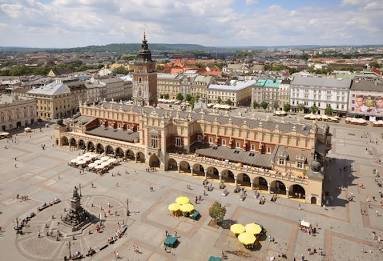
1. The Attack and Vehicular Rampage
At approximately 3:00 PM local time on Saturday, November 7, 2026, the quiet weekend rhythm of Kraków’s historic center was shattered. Witnesses reported that a black Subaru violently bypassed vehicle restriction bollards, driving directly onto the cobblestones of Kraków’s pedestrianized Main Market Square (Rynek Główny).
The shooter—clad head-to-toe in military-style tactical gear—launched the assault directly from his vehicle, firing indiscriminately into dense clusters of local residents, shoppers, and international tourists who had gathered around the outdoor cafes and historic Cloth Hall. The weapon employed was reported by ballistic forensics to be an AR-15-style semi-automatic rifle chambered in high-velocity rifle cartridges.
Rounds ricocheted through the square, shattering storefront glass and sending hundreds scrambling into medieval archways and historic churches for cover. Multiple rounds struck a passing public tram crossing near the perimeter, shattering the driver's cab window; remarkably, neither the tram operator nor passengers sustained gunshot wounds. In the center of the square, two historic carriage horses were struck by incoming fire, though veterinary teams subsequently confirmed both survived their wounds.
2. High-Speed Police Pursuit and Neutralization
Kraków municipal police and patrolling officers reacted with exceptional speed, mobilizing tactical interception units within three minutes of the first emergency call. As the shooter realized armed units were closing the exits from Rynek Główny, he attempted to flee south toward Kazimierz in the black Subaru.
Patrol cruisers forced the suspect's vehicle off course, intercepting him near the critical intersection of Stradomska and Dietla streets. Trapped against the intersection curb, the suspect refused commands to surrender, emerging from the vehicle while continuing to fire his rifle at arriving officers.
Shootout at Stradomska & Dietla
In the fierce close-quarters exchange of gunfire that followed, two responding Kraków police officers sustained gunshot wounds. One officer suffered severe abdominal trauma and was rushed into emergency surgery in serious condition. Despite being struck multiple times by return police fire, the suspect continued discharging his weapon until tactical officers successfully incapacitated him and took him into custody.
3. Casualties and Residential Raid in Ostrowiec Świętokrzyski
Six innocent bystanders—four women and two men—were pronounced dead at the scene across Rynek Główny. Polish emergency health services reported treating at least 15 injured victims at regional trauma centers, five of whom are foreign nationals visiting the historic city. Among the deceased in the square was an identified British national, prompting consular activation from the UK Foreign, Commonwealth and Development Office.
However, the true scale of the horror expanded hours later as counter-terrorism units traced the vehicle's registration back to the suspect’s registered address in Ostrowiec Świętokrzyski, approximately 160 kilometers northeast of Kraków.
When specialized tactical units breached the home, investigators uncovered the bodies of three additional victims—two women and one man. In an evening address to the nation, Polish Prime Minister Donald Tusk disclosed that the deceased discovered at the residence are believed to be the suspect's close relatives (initially suspected to be his parents and sister), raising the total death toll directly tied to the assailant’s rampage to nine.
| Location | Fatalities | Injured | Victim Demographics / Details |
|---|---|---|---|
| Rynek Główny (Market Square) | 6 Bystanders | 15+ Wounded | 4 women, 2 men (including Polish citizens and 1 British national; 5 foreign tourists injured) |
| Stradomska & Dietla Shootout | 0 | 2 Officers + Shooter | 2 police officers wounded (1 in serious condition); suspect wounded and hospitalized |
| Ostrowiec Świętokrzyski Residence | 3 Family Members | 0 | 2 women, 1 man (believed to be suspect's parents and sister; murdered prior to the vehicular attack) |
| Total Aggregate Toll | 9 Dead | 16 Casualties | Culmination of domestic matricide/patricide and public mass terror rampage |
4. The Suspect and Ideological Radicalization Probe
Law enforcement identified the shooter as a 25-year-old Polish national (initially cited in preliminary field reports as 24). The Ministry of National Defence officially verified that the individual possessed no record of service in the Polish Armed Forces or territorial defense formations.
While regional records indicate the suspect held an active civilian sport firearms permit, state prosecutors and the Central Forensic Laboratory of the Police are verifying whether the specific semi-automatic long gun, customized tactical receivers, and substantial stockpiles of loaded magazines recovered from his vehicle were legally registered or modified in violation of Polish firearms laws.
Polish Interior Minister Marcin Kierwiński announced that early digital forensic sweeps of the suspect's electronic devices and online activity point toward significant ultranationalist and far-right ideological radicalization. Counter-terrorism analysts and agents from the Internal Security Agency (ABW) have taken charge of the inquiry, confirming that while all evidence currently suggests the suspect acted alone during Saturday's rampage, operatives are mapping his digital communications to determine whether extremist networks provided inspiration or logistical assistance.
5. Kraków's Historic Heart: Contrast of Heritage and Violence
The attack has reverberated deeply across Europe precisely because of its location. Kraków, officially the Royal Capital City of Kraków, is the second-largest and one of the oldest cities in Poland. Situated on the picturesque Vistula River in the Lesser Poland Voivodeship, the city is home to an urban population of 816,614 (2025 census data), with 1,428,363 residents living throughout the wider Kraków metropolitan area.
Having served as the official royal capital of Poland until 1596, Kraków has traditionally stood as the crown jewel of Polish academic, cultural, and artistic life, boasting the ancient Jagiellonian University and landmark Gothic architecture that largely escaped the physical destruction suffered by Warsaw during World War II. Its magnificent Old Town—centered on the sprawling 40,000-square-meter Rynek Główny—was declared a UNESCO World Heritage Site in 1978 as one of the world's very first heritage inscriptions.
UNESCO Heritage Profile: Kraków Old Town & Rynek Główny
Laid out following the Mongol invasion in 1257, Kraków’s Main Market Square is one of the largest medieval urban plazas in Europe. Surrounded by historic townhouses (kamienice), the soaring twin towers of St. Mary's Basilica, and the iconic renaissance Cloth Hall (Sukiennice), it represents a sanctuary of global tourism and peaceful civic gathering.
For centuries, strict municipal decrees and automated bollards have preserved Rynek Główny as an exclusively pedestrian corridor. The deliberate vehicular penetration and subsequent gunfire strike at the symbolic core of European architectural and civic sanctuary.
6. National Mobilization and Official Citywide Mourning
In Warsaw, Prime Minister Donald Tusk summoned an emergency meeting of the Council of Ministers and the Security and Defence Committee, confirming that federal security forces and intelligence branches have been granted unlimited resource priority to untangle every dimension of the crime.
"This unspeakable tragedy strikes at the heart of our cultural identity and our peaceful nation," Prime Minister Tusk stated in a national televised address. "Poland stands unified in grief with the families of the victims, and in solidarity with the wounded officers who put their lives on the line to prevent further carnage."
In Kraków, Mayor Łukasz Gibała addressed citizens from the City Hall, declaring an official citywide period of mourning extending through Wednesday, November 11—coinciding with Poland's National Independence Day. Cultural events, outdoor concerts, and public entertainment across the city have been canceled, while flags at municipal buildings, university rectorates, and diplomatic consulates fly at half-mast.
As dusk fell over Rynek Główny on Saturday evening, police cordons remained firm around the perimeter of the cobblestone square. Despite rain and tight security sweeps, hundreds of Kraków residents gathered at the edges of the police tape, leaving bouquets of white and red roses and lighting rows of memorial candles in tribute to the nine lives lost.