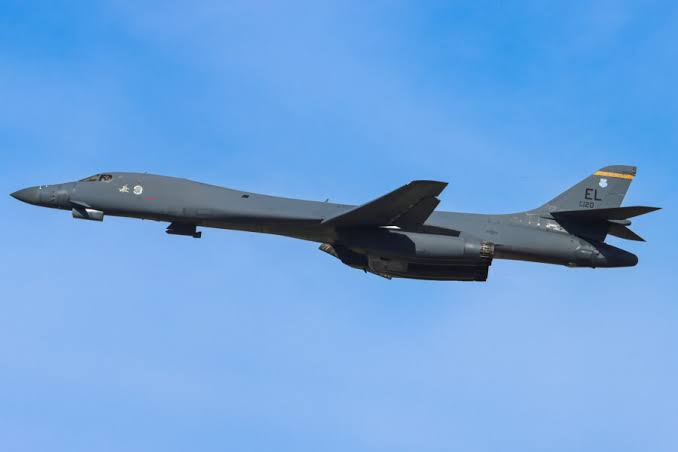
A Sudden Departure and Growing Security Concerns
In an unprecedented operational shift, the U.S. Air Force recently withdrew all of its B-1B Lancer heavy bombers stationed at RAF Fairford in Gloucestershire, England, returning them directly to their home bases in the United States. While military deployments shift constantly, pulling strategic assets out of a primary European forward base due to local force-protection vulnerabilities is exceptionally rare.
The B-1B Lancers had been actively staging out of Fairford to conduct operations targeting regional threats. However, following escalating intelligence reports regarding potential security risks and an alleged terror plot tied to state-sponsored actors, Defense officials made the decision to clear the flight line and eliminate potential ground vulnerabilities.
How the Security Incident Unfolded
The timeline leading up to the redeployment highlights a rapid response by both British counterterrorism law enforcement and military leaders:
Geopolitical Impact and Strategic Realignment
British officials noted strong indications of foreign state involvement in organizing threats against military infrastructure in the region. In response, diplomatic representatives exchanged formal protests as authorities assessed the situation.
From an operational standpoint, this withdrawal shifts long-range strike responsibilities back to continental U.S. bases under Air Force Global Strike Command, relying on extended transoceanic sorties backed by aerial refueling and naval carrier strike groups.
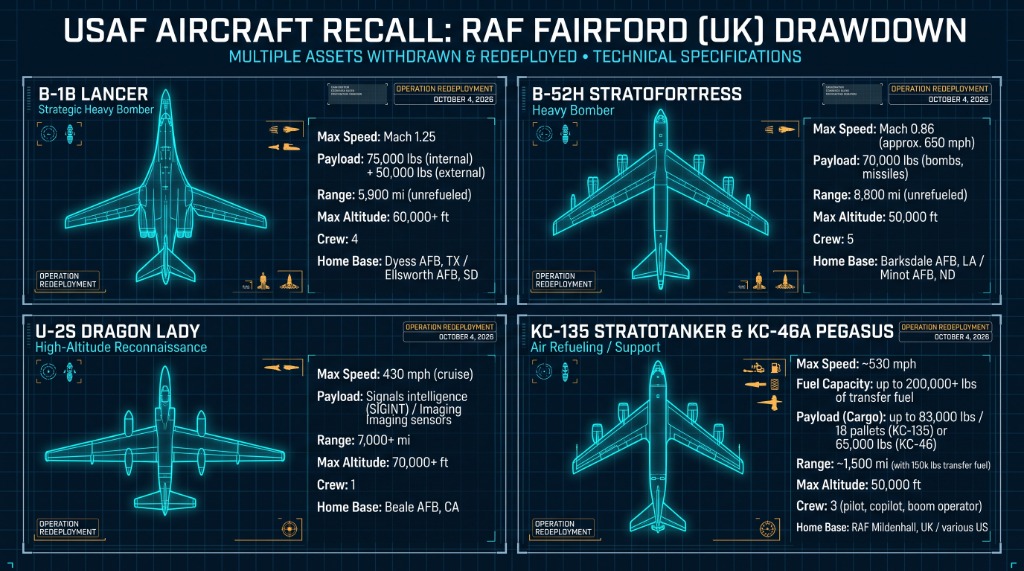
The Fleets and Supporting Units Involved
The active B-1B Lancer fleet primarily operates out of two major home bases within the U.S.:
- Dyess Air Force Base (Texas): Home to the 7th Bomb Wing, including the 9th and 28th Bomb Squadrons.
- Ellsworth Air Force Base (South Dakota): Home to the 28th Bomb Wing, hosting the 34th and 37th Bomb Squadrons.
Alongside the B-1Bs, supporting elements—including aerial refueling tankers and logistics support flights—helped facilitate the transatlantic bridge to safely return airframes and personnel to state-side installations.
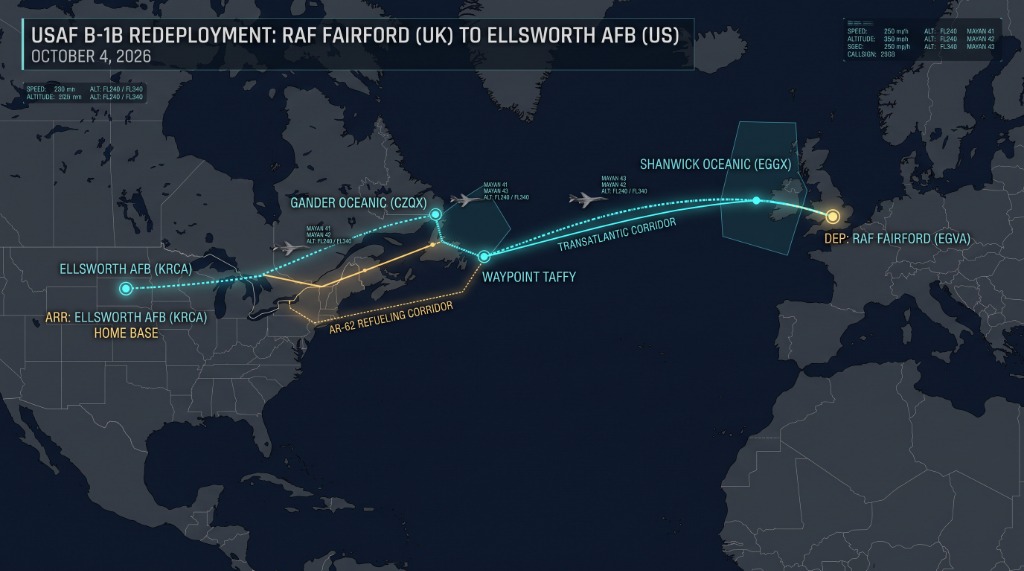
Transatlantic Bridge & Operational Flight Route
U.K. Departure & Marshalling
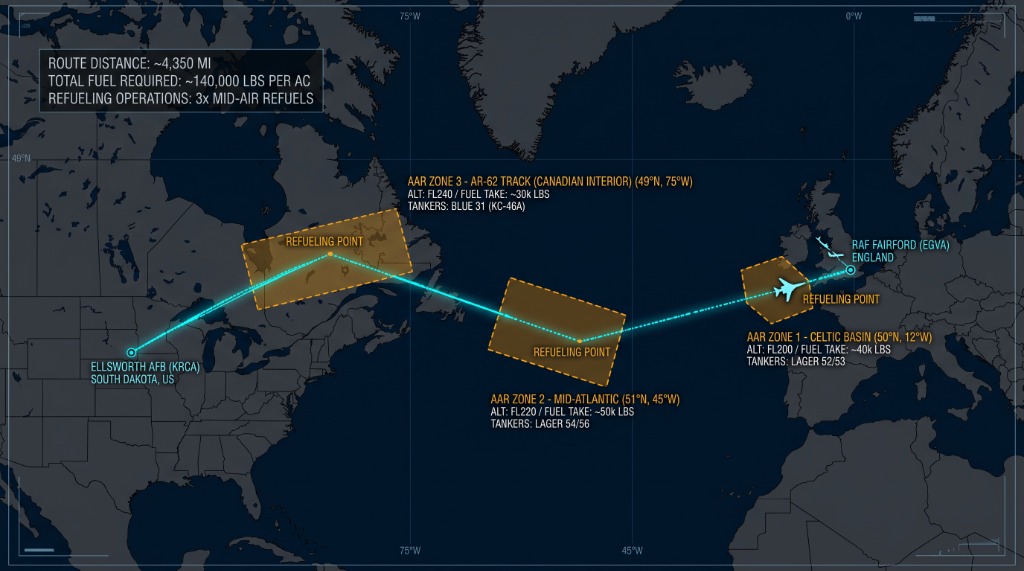
Departed Fairford Runway 27, executing standard military instrument departures climbing west-northwest over the Severn Estuary and Wales toward the Irish Sea. Joined up with 100th Air Refueling Wing tankers in designated domestic refueling tracks over the Celtic Sea/Western Approaches.
Oceanic Clearance & Atlantic Crossing
Entered the Shanwick Oceanic Control Area (EGGX) before transitioning to Gander Oceanic (CZQX). Flown outside civil North Atlantic Track (NAT) structures as a military formation flight using Military Assumed Responsibility for Separation of Aircraft (MARSA) protocols. Altitudes were held between FL200 and FL240 during ocean tanker escort brackets, stepping up to FL340–FL360 during cruise legs.
Canadian Landfall & AR-62 Corridor
Crossed Newfoundland near waypoint TAFFY, routing northwest across Quebec. Utilized the established AR-62 air refueling corridor in Eastern Canada to top off fuel reserves for the overland leg into the central United States.
CONUS Entry & Recovery
Transitioned to civil/military ATC control via Boston ARTCC (ZBW) and handed off across Cleveland (ZAU) and Minneapolis (ZMP) Center airspace. Followed standard northern-tier routes across Michigan and Minnesota, beginning descent over eastern South Dakota to land directly on Runway 13/31 at Ellsworth AFB (KRCA).
Verification and Open-Source Log Checklist
For defense researchers, signals intelligence monitors, and aviation spotters, the redeployment can be independently cross-verified across publicly accessible flight telemetry and ATC recordings:
Query ICAO hex codes #AE6C0B, #AE6C09, and #AE6BFA with UTC timestamps between 10:00Z and 22:00Z on October 4, 2026, to inspect altitude profiles and ground tracks.
Cross-reference LiveATC HF oceanic archives (5.616 MHz, 8.891 MHz, and 13.306 MHz) for Shanwick Radio and Gander Radio check-ins under the MAYAN and LAGER flight strips.
Review KRCA approach/tower logs (UHF 343.725 MHz / VHF 126.05 MHz) for terminal pattern spacing and final approach entries of Cells 1 through 4.
Looking Ahead
By clearing the flight line at RAF Fairford, defense leaders minimized vulnerabilities to valuable military assets while maintaining mission readiness. Future operations will continue through distributed staging bases and long-range missions direct from home bases in North America.