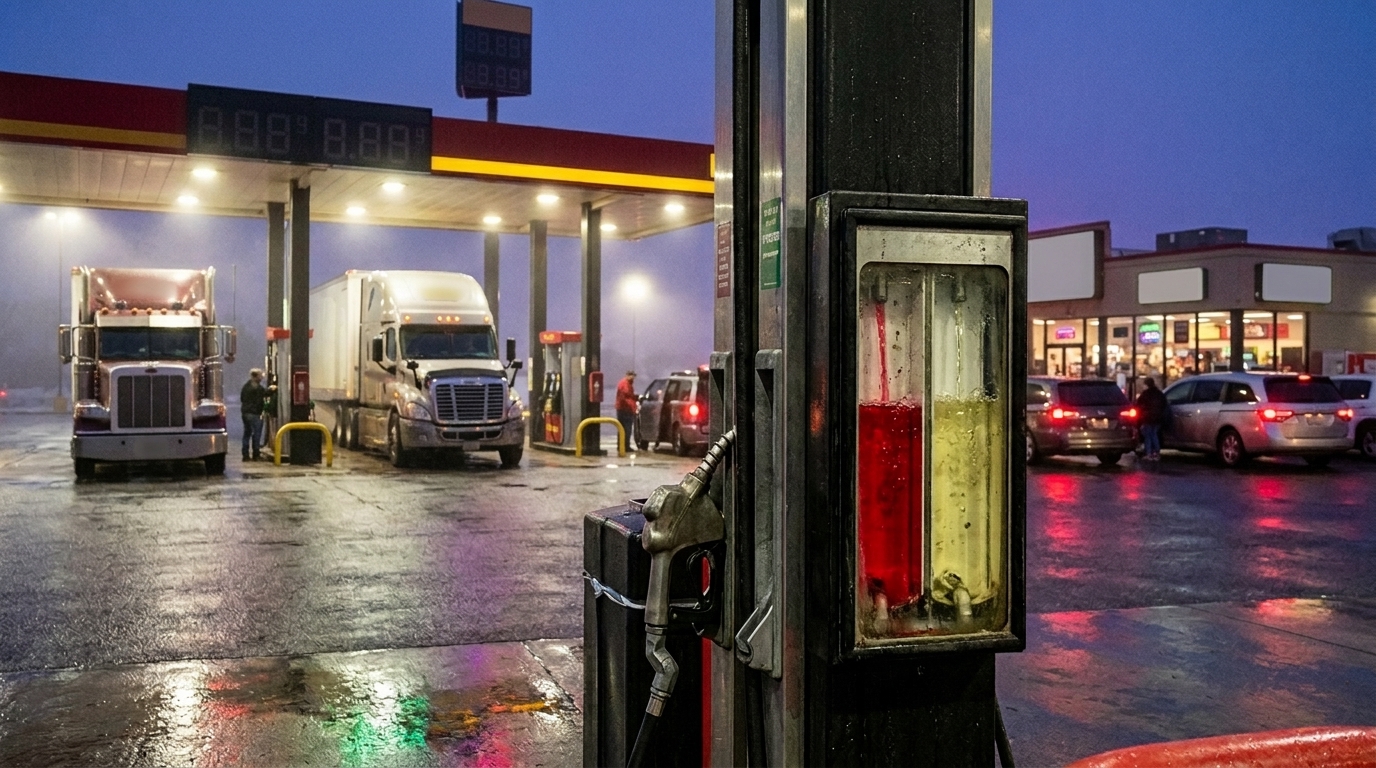
Starting on the West Coast (PADD 5), motorists and commercial operators can expect fuel prices ranging from $5.70 to $5.90 a gallon for gasoline and $7.00 to $7.50 a gallon for diesel.
Moving on to the Midwest (PADD 2), expect a range of $3.80 to $4.50 and $5.80 to $6.50 price per gallon of gasoline and diesel respectively. Finally, the East Coast (PADD 1) is coming in at $3.90 to $4.50 for gasoline and $5.80 to $6.50 for diesel.
These prices are expected to hold through the end of the year. Below, we do a deep dive to pull back the veil and separate fact from fiction.
Q4 2026 Global Fuel Market Outlook: High Crude Benchmarks, Record Pump Prices, and the Red-Dyed Diesel Executive Order
Crude benchmarks and retail fuel prices remain structurally elevated heading into the final quarter of 2026. This ongoing market tightness is driven by conflict-induced supply friction in the Persian Gulf, tanker transit war premiums, and rigid OPEC+ production caps. In response to rising harvest fuel costs, President Trump signed an Executive Order authorizing the use of off-road (red-dyed) diesel on public highways through the end of 2026. However, significant legal, tax, and operational complexities remain for commercial operators.
1. Crude Benchmarks & Price Trajectory (PPB)
Crude oil has experienced a steady upward climb throughout late Q3 and early Q4 2026, with Brent crossing back above the triple-digit threshold.
| Benchmark | Price Per Barrel (PPB) | 30-Day Trend | Immediate Catalyst |
|---|---|---|---|
| Brent Crude | ~$101.50 / bbl | Bullish (+6% to +8%) | Tanker strikes in the Persian Gulf & Strait of Hormuz transit risks |
| WTI Crude | ~$89.50 – $92.50 / bbl | Bullish (+5% to +7%) | U.S. refinery drawdowns & resilient export demand |
| Brent-WTI Spread | ~$9.00 – $11.20 / bbl | Widening | Elevated transatlantic freight & marine insurance war premiums |
2. Geopolitical Turmoil & Supply Bottlenecks
Regional flashpoints are currently the primary drivers of volatility across global barrel balances:
- Middle East & Strait of Hormuz: Sustained military escalation involving Iran, the U.S., and regional allies has directly impacted Persian Gulf shipping corridors. Despite partial bypass routes via overland pipelines (such as Saudi Arabia’s East-West pipeline), regional shut-in capacity averaged 4.8 million barrels per day (bpd) in September and is expected to average 4.5 million bpd through Q4.
- Marine Freight & Insurance Surcharges: War-risk insurance premiums for commercial tankers operating in the Gulf of Oman and Red Sea reached record highs in late September. Tanker diversions around the Cape of Good Hope have tied up global fleet availability, artificially tightening prompt physical supply.
- Eastern Europe & Russian Refining: Ukrainian long-range strikes against Western Russian refining assets have curtailed Moscow's downstream product exports (notably diesel), forcing domestic export restrictions and keeping European distillates tight.
3. OPEC+ Policy Stance
- Quota Freeze: The OPEC+ Joint Ministerial Monitoring Committee (JMMC) agreed to freeze production targets unchanged through November.
- Voluntary Curtailments: The group's voluntary curtailments remain in place, with ministers signaling that planned quota unwinds are frozen until a broader capacity review concludes ahead of 2027.
- Effective Tightness: Because actual member production is lagging target quotas due to regional security disruptions, real physical supply from OPEC+ is even tighter than nominal quota figures suggest.
4. U.S. Retail Fuel Market & Historical Records
Retail fuel prices tracked crude's late-summer rally, posting historically abnormal levels for the autumn transition:
- Current National Average: $4.41 per gallon (Regular Unleaded).
- Record Broken: September closed at an average of $4.33/gal, officially breaking the previous all-time September record of $3.83/gal (set in 2023) by 50 cents.
- Refinery Switch Season: Refineries have completed the seasonal shift to cheaper winter-blend gasoline (which features higher Reid Vapor Pressure), providing a modest 7-cent relief buffer; however, high crude feedstock costs and elevated crack spreads have absorbed most of the typical autumn price drop.
- Diesel Surcharge Pressure: Retail diesel is hovering near $4.85 – $5.10/gal, heavily impacted by tight European inventories and sustained agricultural and freight harvest demand.
5. Q4 Travel Outlook & 2027 New Year Forecast
- Thanksgiving & Holiday Travel Window (Nov–Dec): U.S. retail pump prices are projected to hold in the $4.25 – $4.45/gal range through year-end. High heating oil demand during late Q4 will compete directly with diesel and gasoline refinery yield cuts.
- EIA Q4 Benchmark Projections: The U.S. Energy Information Administration (EIA) projects Brent spot prices to average $105/bbl in Q4, reflecting tight global inventories (drawing by ~0.7 Mbpd).
- New Year & 2027 Forecast: Relief is forecast to be back-half weighted. The EIA projects Brent to decline to ~$87/bbl by Q2 and settle around $74 – $84/bbl toward late in the year as new bypass pipelines in the UAE come online and damaged export capacity normalizes. U.S. retail gasoline is forecasted to average approximately $4.50/gal over the full upcoming year before softening as global reserves replenish.
6. Fact-Checking the Executive Order on Off-Road (Red-Dyed) Diesel
To curb surging autumn harvest fuel costs, President Trump signed an Executive Order authorizing the use of off-road (red-dyed) diesel for on-road and highway vehicles through the end of 2026. While this action provides immediate flexibility, significant legal, tax, and operational friction exists.
| Claim / Perception | Legal Verdict | Practical & Operational Reality |
|---|---|---|
| "The President eliminated the fuel tax." | FALSE | Under the U.S. Constitution, only Congress can permanently repeal or eliminate taxes. The Executive Order exercises federal enforcement discretion to defer collection of the 24.4¢/gal federal excise tax through year-end. Without retroactive congressional relief, drivers and fleets remain technically liable for those deferred taxes starting January 1. |
| "Dyed diesel is now legal on all roads." | PARTIALLY TRUE | Federal authorities have suspended roadside enforcement and penalties, but state fuel taxes and road laws remain under state jurisdiction. Unless individual state governors issue mirror executive orders, operating with dyed diesel on state roads can still trigger state-level fines and fuel-tax evasion penalties. |
| "Chemical / Physical Fuel Differences exist." | FALSE (Identical) | Chemically and mechanically, off-road and on-road diesel in the U.S. are the exact same Ultra-Low Sulfur Diesel (ULSD, max 15 ppm sulfur). The only difference is the solvent red dye (Solvent Red 164), added strictly for tax identification. |
| "Operational Exit Trap for Fleets" | HIGH RISK | Red dye is chemically persistent and typically requires 6 to 8 full tank fills of clear diesel to wash out of a vehicle's fuel system. Once the emergency waiver expires at year-end, any lingering red residue detected during routine DOT or state roadside dip-tests risks triggering statutory penalties. |
7. Historical Precedence vs. The 2026 Precedent Shift
Standard Disaster-Specific Waivers (Historical Precedent)
Historically, the IRS and the EPA issue temporary dyed-diesel waivers under Section 211 of the Clean Air Act exclusively during localized, acute logistical crises caused by severe natural disasters or pipeline halts:
- Hurricane Sandy (2012): The IRS waived tax penalties for dyed diesel in New York and New Jersey due to terminal flooding and localized clean fuel shortages.
- Hurricanes Harvey & Irma (2017) and Idalia (2023): Emergency IRS waivers permitted emergency response fleets and fuel haulers in Florida, Texas, and the Southeast to use dyed stock when retail supplies were physically cut off.
- Colonial Pipeline Cyberattack (2021): Temporary waivers permitted off-spec and dyed product movements along the East Coast while the primary pipeline was offline.
The 2026 Policy Shift
Past statutory waivers were strictly confined to:
- A narrow geographic emergency zone (1 to 3 states).
- A tight 15-to-20-day maximum statutory window under the Clean Air Act.
- Physical supply outages rather than market price mitigation.
Applying an executive order nationwide through the end of a calendar quarter for price relief and general harvest affordability—rather than a localized terminal disaster—marks an unprecedented expansion of federal fuel enforcement discretion.
8. Immediate Action & Verification Steps for Commercial Operators
Check your state department of revenue or state trucking association before fueling over-the-road assets. Do not rely solely on the federal order if your state has not waived local road taxes.
Maintain detailed bulk purchase invoices and vehicle fuel logs to document tax deferral liabilities in the event Congress does not forgive the deferred balances prior to January 1.
If operating commercial interstate equipment, transition vehicles back to clear road diesel several weeks before December 31 to fully dilute the red dye from tanks, filters, and fuel lines.
Cross-Desk Telemetry Integration
Correlated against EIA weekly storage reports, Chicago Mercantile Exchange (CME) ultra-low sulfur diesel crack spreads, and AIS global tanker route diversions around the Cape of Good Hope.