AI in the Cockpit: How Close Are We to Autonomous Flying Taxis and Personal VTOLs?
The vision of summoning an autonomous electric aircraft to soar above gridlocked traffic has attracted tens of billions in capital. But as FAA regulators scrutinize software edge cases, where does reality stand in August 2026?
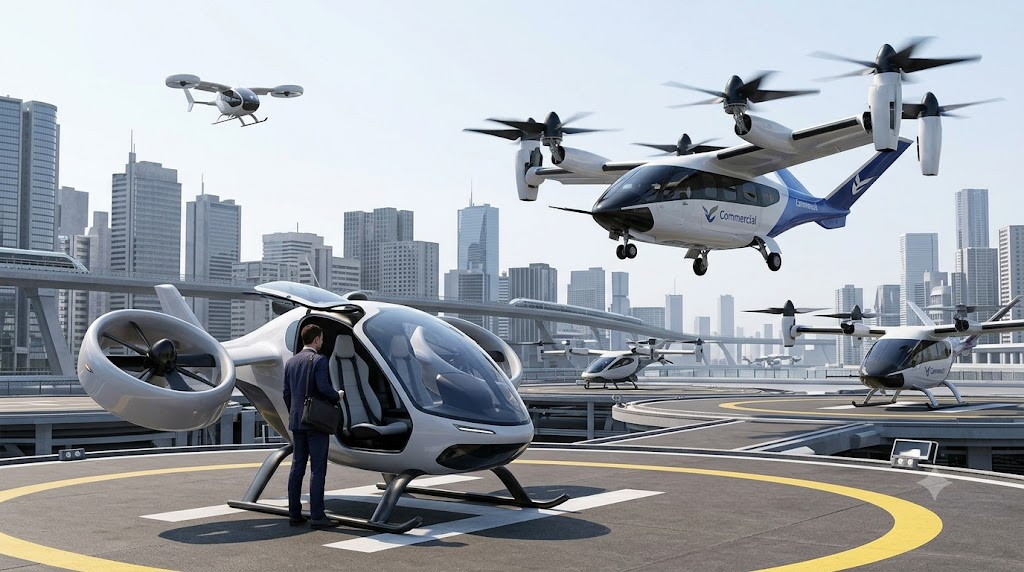
The vision is intoxicating. You step out of your apartment, summon a sleek electric aircraft from your phone, and minutes later you're soaring above gridlocked traffic — no pilot, no delay, no emissions. The aircraft's AI handles everything: takeoff, navigation, collision avoidance, landing. You're just a passenger, scrolling through emails as the skyline slides past your window.
It's the dream that has fueled billions in investment, spawned dozens of startups, and captured the public imagination for over a decade. But here in August 2026, with real hardware in the air and the FAA actively certifying these machines, where do we actually stand?
The answer is more nuanced — and more interesting — than the headlines suggest.
The State of Play: Who's Flying What, Right Now
Let's cut through the hype. Here's where the major players actually are across flight hardware and regulatory progress:
| Company | Aircraft | AI / Autonomy Level | Certification Status | Realistic Timeline |
|---|---|---|---|---|
| Joby Aviation | S4 eVTOL | Piloted + assist | FAA TIA granted; Stage 5 | 2027–2028 |
| Archer Aviation | Midnight | Piloted + assist | Phase 4 FAA testing | 2028 (LA Olympics) |
| Wisk Aero (Boeing) | Gen 6 | Fully autonomous | Type certification in progress | Late 2020s |
| Vertical Aerospace | Valo | Piloted; autonomy in dev | EASA primary; FAA in progress | 2028 |
| Doroni Aerospace | H1-X | AI Copilot (SOUL.AI) | MOSAIC pathway | 2028 deliveries |
| Skyfly | Axe | Piloted personal eVTOL | MOSAIC pathway | 2027 |
| AIR | AIR ONE | Piloted personal eVTOL | Experimental → MOSAIC | Early 2027 |
The AI Spectrum: From "Smart Autopilot" to "No Pilot At All"
When people imagine "AI flying a VTOL," they're usually picturing full autonomy — the aircraft as a robot chauffeur. The reality is a spectrum, and different companies are placing very different bets:
Level 1: AI-Assisted Piloted Flight (Where Most Are)
Joby, Archer, Vertical Aerospace, and Beta Technologies — the biggest names by market cap — are all pursuing piloted aircraft first. Their AI systems assist with flight envelope protection, navigation, energy management, and situational awareness, but a human pilot remains in command.
This isn't because they don't believe in autonomy. It's because certification is hard enough without adding the unprecedented challenge of convincing regulators to let software fly passengers alone. Vertical Aerospace's partnership with Near Earth Autonomy and Honeywell's Anthem digital cockpit points toward progressive automation, starting with defense applications where the risk calculus is different.
Level 2: The AI Copilot (Personal VTOLs)
Doroni Aerospace has taken a fascinating middle path with its H1-X personal eVTOL. Their SOUL.AI™ system is marketed as an "intelligent digital copilot" — it doesn't replace the pilot, but it dramatically simplifies the flying experience. The company claims users will need only around 25 hours of training, compared to the hundreds required for a private pilot license.
SOUL.AI handles navigation guidance, system monitoring, and flight envelope protection — functioning like Tesla's Autopilot for the sky. Doroni has over 600 pre-orders ($240M+ in potential revenue), raised $35M from 12,000+ retail investors, and unveiled the production airframe in Dania Beach, Florida in March 2026 with deliveries targeted for 2028.
Level 3: Full Autonomy — The Wisk Bet
Then there's Wisk Aero, Boeing's wholly-owned subsidiary, which has staked its entire business model on full autonomy from day one. No pilot on board. No cockpit. Just passengers and software.
In December 2025, Wisk flew its Generation 6 aircraft for the first time — the first-ever candidate for FAA certification of an autonomous passenger-carrying aircraft in the United States. In July 2026, Wisk tested a 1:3 supervisor ratio with NASA: one human on the ground monitoring three autonomous aircraft simultaneously.
"Seeing Gen 6 take flight is an exciting moment for Wisk and the future of aviation. It reaffirms our belief in autonomy." — Sebastien Vigneron, CEO of Wisk
Wisk's model eliminates pilot costs and targets human error (which accounts for ~80% of aviation accidents), but the certification bar is astronomically high.
The Hybrid Pivot: Why Everyone Suddenly Loves Jet Fuel Again
One of the biggest stories of 2026 is the industry's sharp turn toward hybrid-electric powertrains — and it's directly tied to the autonomy conversation.
The original pitch was all-electric, battery-powered eVTOLs for short urban hops. But when companies started courting defense contracts, the military's feedback was blunt:
"The feedback was there really isn't a mission for a battery-electric eVTOL that solves a defense problem today." — Tom Muniz, CTO of Archer Aviation
The result? At the Farnborough International Airshow in July 2026, Archer unveiled Halo — a fully autonomous, hybrid-electric tiltrotor developed with defense tech company Anduril. It burns jet fuel to charge batteries that power electric rotors. Range: dramatically longer. Payload: substantially heavier. Pilot: none.
Anduril simultaneously unveiled Thunder, the armed defense variant. This dual-use strategy allows companies to mature autonomous flight software in defense missions with paying military customers before facing commercial FAA passenger scrutiny.
The Regulatory Reality Check
For all the gleaming prototypes and slick renderings, the FAA remains the ultimate gatekeeper — and it is not in a hurry. The certification process involves multiple phases:
- Familiarization: FAA learns about the novel aircraft design.
- Airworthiness Criteria: Agreeing on what "safe" means for this new category.
- Means of Compliance: How the manufacturer will prove safety.
- Conformity & Testing: Building and testing to those standards.
- Type Inspection Authorization (TIA): FAA test pilots fly the aircraft.
- Type Certificate: The golden ticket for commercial operations.
The FAA's new MOSAIC rule (Modernization of Special Airworthiness Certification) has opened a faster pathway for smaller personal eVTOLs like the AIR ONE and Skyfly Axe — treating them more like advanced light sport aircraft than commercial airliners. This is likely where the first consumer-owned VTOLs will emerge, possibly as early as 2027.
Meanwhile, the Trump administration's eVTOL Integration Pilot Program (eIPP) — launched in 2025 with 8 industry partners and 26 states — is designed to accelerate real-world testing. But demonstration is not certification, and certification is not commercial service.
The Lawsuits, The Bankruptcies, The Bloodbath
It's not all smooth skies. The industry is also cannibalizing itself:
- Joby sued Archer for alleged corporate espionage.
- Archer countersued Joby, accusing it of hiding ties to China and misclassifying aircraft parts as "hair clips" and "socks."
- Archer sued Vertical Aerospace for patent infringement.
- Lilium — once a $3B+ market-cap pioneer — filed for insolvency in late 2024 and collapsed.
- Volocopter scrapped its Paris Olympics launch after engine certification failed.
Stock performance in 2026 tells its own story: Archer down 9%, Beta down 50%+ from first close, Vertical down ~50% from 2025 levels. Only Joby has held relatively steady, buoyed by its certification lead and Toyota's nearly $900M in backing.
"If Joby, Archer, Vertical and Eve go down, we're going to go down with them." — Kyle Clark, CEO of Beta Technologies
So, When Do You Get Your AI Flying Car?
Let's be honest about realistic deployment horizons:
1. Personal VTOLs (You Fly, AI Assists): 2027–2028
This is the most realistic near-term scenario. Companies like AIR, Skyfly, and Doroni are targeting the MOSAIC light-sport pathway. The AIR ONE has over 2,500 pre-orders and could deliver experimental-category aircraft by early 2027. You'll need training — but not a full commercial pilot's license. The AI copilot will handle cognitive load.
Price range: $200,000–$400,000+ (High-end enthusiast market).2. Air Taxis (Human Pilot On Board): 2028–2030
Joby and Archer are targeting the 2028 Los Angeles Olympics as a coming-out party. Joby has an exclusive six-year deal for Dubai air taxi services. Archer bought Hawthorne Airport near LAX for $126 million. Expect limited, geo-fenced operations in select flagship cities rather than ubiquitous sky transport.
3. Fully Autonomous Passenger VTOLs (No Pilot): 2030s
Wisk's Gen 6 is flying, but passenger autonomous flight certification is unprecedented. The FAA will require millions of flight hours proving AI can handle all edge cases. Autonomous VTOLs will debut in cargo and defense roles first (Archer's Halo and Anduril's Thunder) before passengers are permitted on board.
The Bottom Line
The AI-powered VTOL revolution is real — but it's arriving in stages:
- The first VTOL you can buy will be a personal aircraft with AI assistance, not full autonomy.
- The first air taxi you ride will have a human pilot in the cockpit.
- The first fully autonomous VTOL will carry cargo and defense payloads, not people.
"Common" is still a decade away. Infrastructure — vertiports, megawatt charging networks, air traffic integration, insurance, and public acceptance — lags far behind airframes. The workhorse of the sky is coming. It's just not in a hurry.