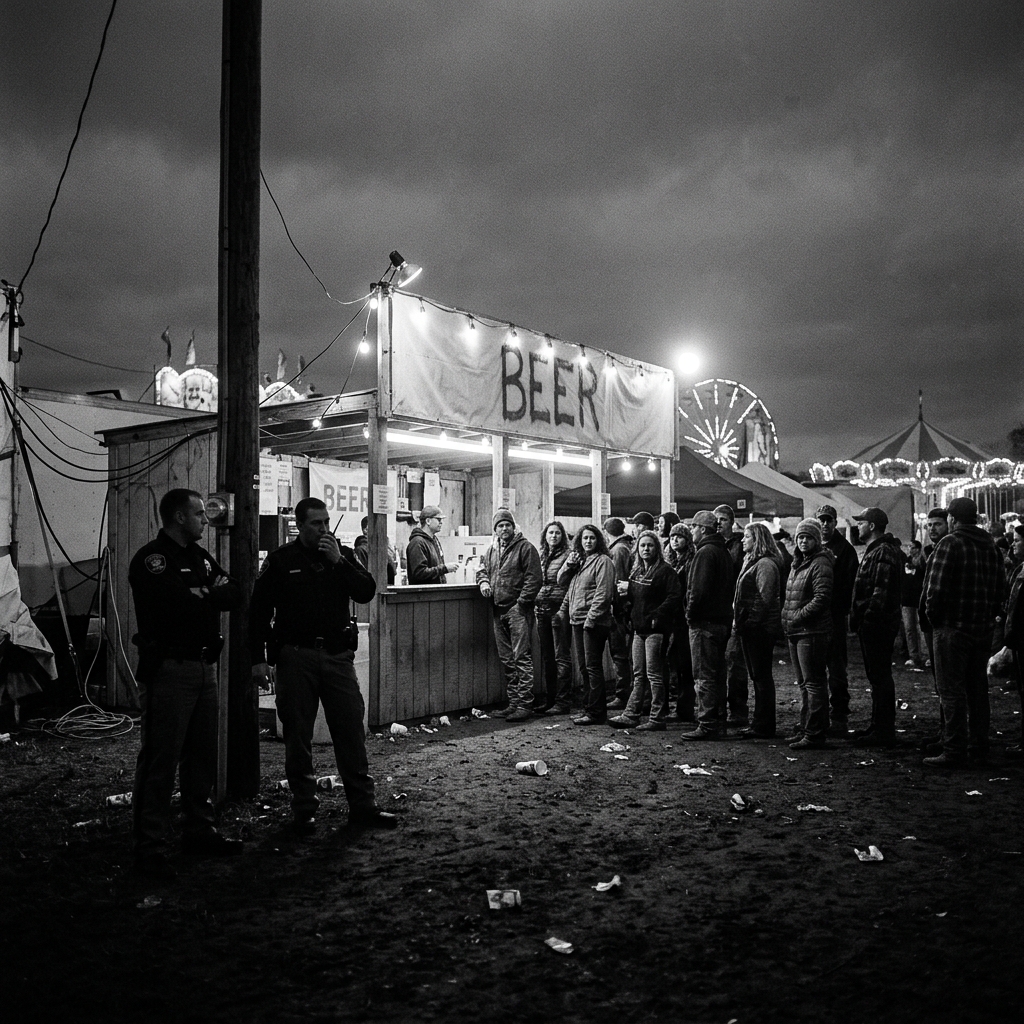
SIKESTON, Mo. — Ricardo Montes walked into the Sikeston Jaycee Bootheel Rodeo on Saturday night in a plaid shirt and cowboy hat, same as he'd done for years. He walked up to a beer tent, handed over his identification for a 21-and-over wristband, and waited.
The scanner read his ID in under a second. It didn't just check his birthday. It pulled his full name, his address, his license number, his gender, his height, his eye color — every data point encoded in the PDF417 barcode on the back of a Missouri ID or he presented an invalid form. Depending on the source.
WHAT WE DO KNOW
The device — whichever brand it was, and nobody will say — was connected to the internet. That's how these machines work. They need the connection to check against fake ID databases, to sync with cloud servers, to log the scan for the compliance audit trail. And, increasingly, to cross-reference the person holding the ID against a sprawling, largely unregulated network of federal and private databases that has nothing to do with buying a beer.
Within minutes, Montes was in handcuffs. Plainclothes ICE agents — who had been stationed at the rodeo all four nights, embedded with local law enforcement under Scott County's 287(g) agreement — led him away as his wife struggled with the events taking place and his daughter filming the incident on her phone.
"I didn't know this was going to happen," Sandy Gonzalez said, fighting back tears.
The charge wasn't underage drinking. It wasn't disorderly conduct. Montes, a longtime Sikeston resident, had "existing immigration-related matters in federal systems," according to the Sikeston Department of Public Safety. The ID check at the beer tent had surfaced them.
THE BLACK BOX AT THE BEER TENT
Sikeston DPS and Scott County Sheriff Derick Wheetley have been careful to frame what happened as routine. "Technology is used at these checkpoints to assist with verifying a person's age, the validity of the identification presented, and how many times an identification has been scanned," Wheetley explained. An important safeguard, he said, to prevent wristband sharing.
But when reporters asked what information officers checked, which databases were queried, or why an age-verification scan resulted in a federal immigration arrest, the department declined to answer. They still haven't.
Here is what we know about how these systems actually work.
The age-verification scanners deployed at liquor stores, bars, convenience stores, and events across America — manufactured by companies like Patronscan, ID Verify, PulseID, and ViAge — are not standalone calculators. They are internet-connected surveillance nodes. When you hand over your ID, the scanner ingests every data field encoded in the barcode: name, address, date of birth, license number, gender, eye color, height, weight, organ donor status, license class and restrictions. It runs the data through forensic authentication — Patronscan's flagship device checks 8,500 data points per scan. Then it transmits the scan to cloud servers, where it is retained for 21 to 90 days depending on the jurisdiction.
The internet connection is not optional. Patronscan's own documentation states that its devices "connect via Wi-Fi or Ethernet so it can run real-time fake ID checks, sync flag data across the network, and log scans to your admin portal." The company's new "Third-Party Checks" feature cross-references every scan against OFAC sanctions lists, Interpol wanted-persons databases, and national sex offender registries — all in real time, all at the point of sale.
And when law enforcement wants scan records, Patronscan handles the request directly. The venue owner never sees it.
THE NETWORK NOBODY TALKS ABOUT
The scanner at the Sikeston rodeo didn't need to be running immigration queries itself. It just needed to be connected to a system that was.
Scott County is one of 39 Missouri jurisdictions enrolled in ICE's 287(g) program, which deputizes local law enforcement to perform federal immigration enforcement functions. Missouri State Highway Patrol has 53 troopers certified under 287(g). Nationwide, ICE has 1,317 agreements across 40 states.
Meanwhile, ICE has been building a parallel biometric surveillance apparatus. In June 2026, the agency finalized plans to distribute a mobile facial recognition app — called Mobile Fortify, or the Task Force Module — to more than 1,000 local law enforcement agencies. The app allows officers to photograph someone in the field, run their face against 250 million DHS and State Department records, and receive a text-message response instructing them whether to detain the person. Photographs and geolocation metadata are retained for 15 years. Individuals are given no notice. U.S. citizens are not excluded from the searches.
ICE also signed a $25 million no-bid contract with BI2 Technologies for 1,500 iris-scanning devices, granting agents access to a private database of more than 5 million biometric records — no federal security certification required, no independent audits.
The ID scanner at the rodeo beer tent sits at the intersection of these two systems: the private, commercial surveillance network that logs every drink you buy, and the federal immigration enforcement apparatus that is increasingly hungry for data.
THE WARNINGS WE IGNORED
None of this should be a surprise.
In 2018, the California Legislature investigated Patronscan and discovered the company had collected and retained information on 561,087 people in Sacramento in five months — more than the city's entire population. The company was building databases tracking "where customers live, how far they have traveled, and how many different venues the customers patronized."
The Coalition for Human Immigrant Rights warned at the time that "placing individuals on a database that labels them a 'threat to public safety' has significant immigration consequences that could lead to deportation, revoking of current status, or denial of future immigration relief."
In 2021, the Alberta Privacy Commissioner investigated Patronscan's deployment at liquor stores and found the system was initially collecting every single data element encoded in the barcode — including vehicle class, license restrictions, and full address — even though the company claimed it only retained name, age, gender, and partial postal code. The Commissioner ordered the practice stopped. The company complied — in Alberta.
In August 2026, three days before the Sikeston arrests, the Electronic Frontier Foundation published an investigation revealing that Patronscan scanners had been deployed at LGBTQ+ bars in San Francisco's Castro district. The headline: "Why Are Gay Bars Building Databases Of Their Patrons?"
"HE WAS SINGLED OUT BECAUSE HE'S BROWN"
The Sikeston rodeo draws 40,000 to 50,000 people over four nights. It's one of the largest volunteer-run rodeos in the country. This year's Saturday night headliner was "That Mexican OT," a popular Mexican American rapper.
Montes's son-in-law, Justin Staggs, wrote on social media: "My father in law is the most honest and hard working man I know and wasn't causing any trouble tonight. He was singled out because he's brown at a place where a Mexican rapper is performing. ICE isn't taking any hardcore criminals off the streets by targeting brown people at a rodeo. They are targeting hardworking, honest, good people at the rodeo grounds."
Sikeston DPS disputes that anyone was randomly targeted. The department says ICE was there to "increase cooperation and working relationships between federal and local law enforcement agencies." Each arrest, they insist, was prompted by someone seeking a beer wristband.
Which is exactly the point.
The scanner at the beer tent is the perfect surveillance device precisely because it doesn't look like one. It's not a checkpoint. It's not a raid. It's just the thing you have to do to get a drink. You volunteer your ID. You hold it under the laser. You wait for the green light. You don't ask where your data is going, or which databases it's being checked against, or whether the plainclothes agents standing near the funnel cake stand are running your name through a federal immigration system before you've finished your first Bud Light.
You just wanted a beer at the rodeo.
THE SHOW ME STATE
Missouri's nickname is the "Show Me State." The phrase is usually attributed to Congressman Willard Duncan Vandiver, who said at an 1899 naval banquet: "I come from a state that raises corn and cotton and cockleburs and Democrats, and frothy eloquence neither convinces nor satisfies me. I am from Missouri. You have got to show me."
The Sikeston Department of Public Safety has not shown us what technology was used at the rodeo beer tent. It has not shown us which databases were queried. It has not shown us the chain of information that transformed an age check into an immigration arrest. It has not shown us the agreement between the rodeo, the scanner vendor, the sheriff's office, and ICE.
What it has shown us is the future: a world where buying a beer means submitting to a federal background check, where the infrastructure of casual commerce doubles as the infrastructure of mass surveillance, and where the scanner at the concession stand sees more than the cop on horseback ever could.
Ricardo Montes is being held at the Ste. Genevieve Detention Center. His family is raising money for a lawyer. The rodeo has moved on to next year's planning. The scanners are still at the beer tents. They're still connected to the internet. And they're still running checks that nobody will explain.
And while Mr. Montes was the catalyst here he will most likely be home after taking care of whatever affairs is necessary through the immigration court.
And the real story here will continue lost in the emotions of race and legal struggle. And that is mass surveillance and government overreach from the highest level to the lowest — they are playing ball together and using the old parents routine where they are blaming each other for actions but secretly have the same goal.
Show me, Missouri.