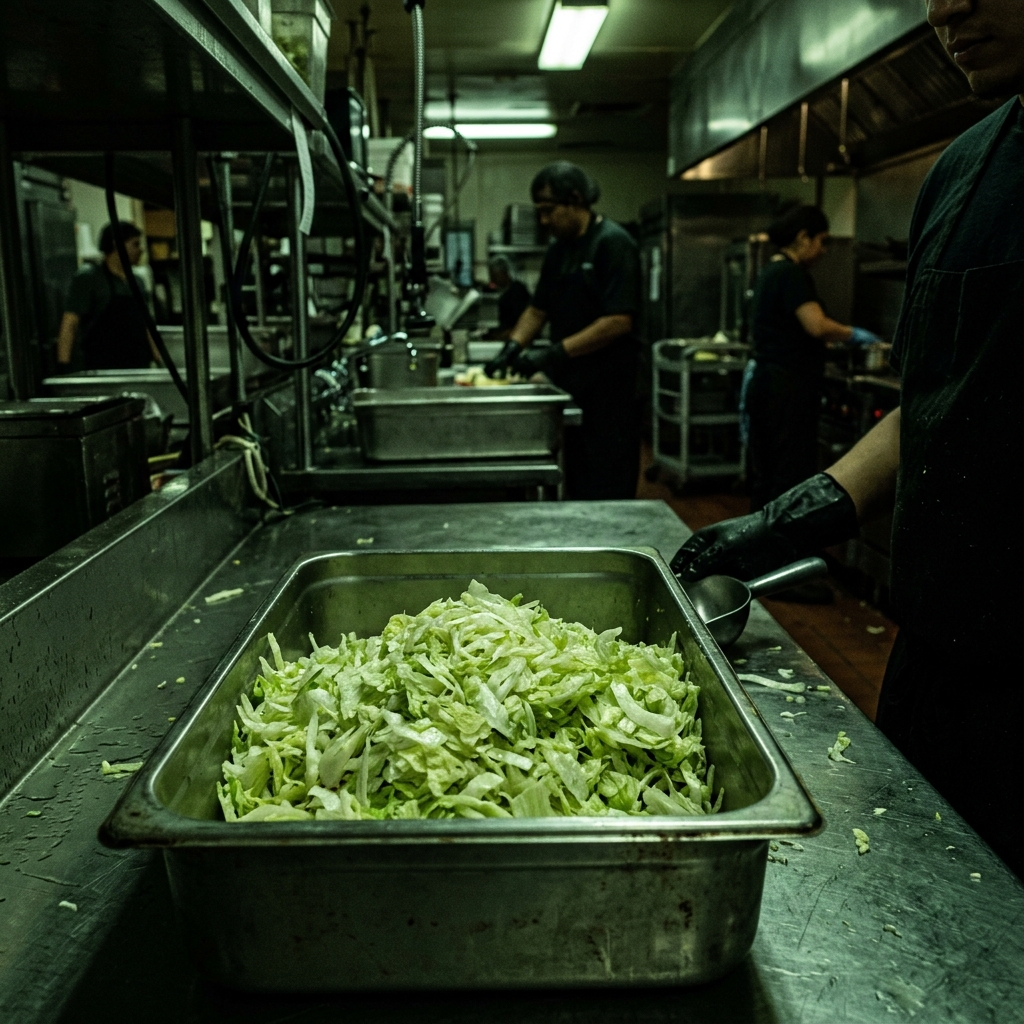
BENTONVILLE, Ark. — The numbers don't make sense until you see them side by side.
Seven. That's how many cases of cyclosporiasis Arkansas recorded in all of 2025. A rounding error. The kind of statistic that gets a single line in an annual report and no one reads it.
Two hundred and thirty-seven. That's the count as of Friday, August 7, 2026. One hundred and forty-four of those are in Benton County alone — the Walmart headquarters, the booming northwest corridor, the land of new subdivisions and packed lunch-hour Taco Bells. Twenty new cases in Benton County since Wednesday. The map on the Arkansas Department of Health website now shows infections in 22 counties, from Baxter to Woodruff, and the investigation is "going to continue as long as there's cases."
Nationally, the outbreak has sickened at least 10,468 people across 45 states since May 1. Five hundred and seventeen have been hospitalized. Two are dead — both in Michigan, both with "significant underlying health conditions" that the parasite exploited.
The source, according to the FDA and CDC: shredded iceberg lettuce grown in central Mexico by Taylor Farms de Mexico, a subsidiary of the Salinas, California-based Taylor Fresh Foods — the self-described "leading global producer of salads and healthy fresh foods," a company that says it spends $200 million a year on food safety.
The lettuce was served at Taco Bell. It was sold at Walmart under the Marketside brand. It was distributed to food service customers in 27 states. The recall came on July 17. By then, people had been getting sick for nearly a month.
THE PARASITE
Cyclospora cayetanensis is a microscopic parasite. It spreads through food or water contaminated with human feces. It is not passed from person to person — you cannot catch it from someone on the bus or in the office. You can only ingest it.
Once inside the body, it takes about a week to make itself known — though the incubation window runs anywhere from two days to two weeks. Then comes the diarrhea. Watery, frequent, relentless. Loss of appetite. Weight loss. Stomach cramps and bloating. Nausea, fatigue, vomiting, body aches, fever. And the cruelest trick: symptoms can fade, make you think you're recovering, then come roaring back. Relapse is a hallmark of cyclosporiasis.
Most people recover without treatment. But for the immunocompromised, the elderly, the very young, or those with underlying conditions, the dehydration and complications can be severe — even fatal.
The two people who died in Michigan became ill before the recall was issued. By the time Taylor Farms pulled its lettuce from the market on July 17, the contaminated product had already been on shelves, in restaurant kitchens, and on dinner plates for weeks.
THE TRACEBACK
The investigation began in early July, when public health officials in Michigan and Ohio noticed an unusual spike in cyclosporiasis cases. The CDC's national surveillance system started lighting up. By mid-July, epidemiologists had zeroed in on a common thread: Taco Bell.
Interviews with sick people revealed that 90% of those who could recall what they ate had consumed iceberg lettuce. The FDA's traceback investigation followed the supply chain backward — from Taco Bell locations in Indiana, Kentucky, Michigan, Ohio, and West Virginia, through distribution centers, to a single supplier: Taylor Farms de Mexico, in Guanajuato, Mexico.
On July 17, Taylor Farms announced a voluntary recall of all iceberg lettuce sourced from central Mexico. The company said it was acting "out of an abundance of caution." It suspended all production at its central Mexico facility. It commissioned independent experts to conduct a "top-to-bottom review" of its food safety processes.
Then came the false positive.
On July 18, the FDA announced it had detected Cyclospora in a sample of Taylor Farms lettuce. The company demanded a retraction. Within 24 hours, the FDA walked it back — the result was a false positive, a laboratory error. Taylor Farms posted a statement beginning with the words "Today, FDA apologized to us," then deleted it.
But the FDA did not back down from its central finding. "FDA's traceback investigation and outbreak data continue to converge on shredded iceberg lettuce from Taylor Farms locations in central Mexico," the agency said. The epidemiological evidence was, in the FDA's word, "overwhelming."
As of August 5, the FDA still had no confirmed positive product test for Cyclospora. The entire case against the lettuce rests on what epidemiologists call "convergence" — the statistical alignment of who got sick, what they ate, and where it came from. It is the same method that has solved countless foodborne outbreaks. It is also, in the absence of a smoking-gun lab result, a method that leaves room for doubt.
WHY BENTON COUNTY?
The concentration of cases in northwest Arkansas — 144 in Benton County, 22 in Washington County, 19 in Boone, 11 in Carroll — is striking. More than 70% of the state's cases are clustered in four counties in the northwest corner.
The Arkansas Department of Health has an explanation, and it's not necessarily that people in Benton County ate more tainted lettuce. "The concentration of Arkansas cases in the northwest counties was likely due to multiple factors, including differences in testing and reporting practices across healthcare facilities," said Dr. Cassandra Lautredou, the department's medical director for outbreak prevention and response.
In other words: northwest Arkansas has better hospitals, more aggressive testing protocols, or both. The cases may be everywhere. They're just being found in Bentonville and Fayetteville.
But the health department is also investigating whether additional sources beyond Taylor Farms lettuce are contributing. "While some cases are associated with the multistate outbreak linked to Taylor Farms' iceberg lettuce and Taco Bell, the Arkansas Department of Health's investigation is ongoing to determine whether additional sources may also be contributing," Lautredou said.
The recall covered far more than Taco Bell. Taylor Farms' shredded iceberg lettuce was distributed to food service customers in 27 states under multiple brand names. The Marketside-brand products sold at Walmart — 12-oz and 24-oz Iceberg Salad, 8-oz and 16-oz Shredded Lettuce — were on shelves in Arkansas. The "best if used by" dates ran through August 3. Some of that lettuce may still be in refrigerators.
THE COMPANY
Taylor Farms is not a fly-by-night operation. It is the dominant force in American fresh-cut produce. It co-founded the Center for Produce Safety. It helped create the California and Arizona Leafy Green Agreements that set food safety protocols for growers. It invented SmartWash Solutions, a USDA-tested wash system. It is a pioneer in traceability — each product can be traced back to the grower, ranch, lot, harvest date, and time.
The company spends $200 million annually on food safety. Its facilities hold SQF certification and GFSI recognition. Its ranches undergo annual third-party audits. Its water is tested. Its workers are trained. Its equipment is state-of-the-art.
And yet.
Last year, a Taylor Farms facility in Colorado was linked to an E. coli outbreak that forced McDonald's to stop serving onions on Quarter Pounders. This year, Taylor Farms de Mexico is at the center of the largest cyclosporiasis outbreak in American history.
The company has suspended all iceberg lettuce sourcing and production from central Mexico. It says it is cooperating with investigators. It says it is "deeply concerned for those who became ill, their families, and the many Americans whose trust in the safety of their fresh produce has been shaken."
It also says, pointedly, that no Taylor Farms-branded salads or kits are associated with the outbreak. The contaminated product was sold to food service and under retailer brands. The name on the bag at Walmart was Marketside. The name on the taco was Taco Bell. The name on the supply chain was Taylor Farms.
WHAT NOW
The CDC says the outbreak may be slowing nationally. New laboratory trends offer "cautious hope." But case counts remain high, and the true scope is almost certainly larger than the official numbers suggest. Most people with cyclosporiasis recover without seeing a doctor. Many who do see a doctor are never tested. The CDC estimates only 1 in 30 cases is officially diagnosed.
In Arkansas, cases are still trending up. The health department added 35 new cases between Wednesday and Friday alone. The investigation continues. The advice to the public is simple and familiar: wash your produce, cook it when you can (158°F kills the parasite), refrigerate cut fruits and vegetables within two hours, and if you develop persistent watery diarrhea — especially if it seems to get better and then comes back — call your doctor.
The broader question is harder. Taylor Farms spent $200 million on food safety and still shipped contaminated lettuce to 27 states. The FDA's traceback system worked — it identified the source, triggered a recall, and got the product off the market. But it worked reactively, after thousands of people had already eaten the lettuce, after two people had already died.
The global food supply chain is a miracle of efficiency and a nightmare of vulnerability. A single facility in Guanajuato, Mexico, can sicken people in 45 states. A parasite invisible to the naked eye can travel from a field in central Mexico to a Walmart in Bentonville to a Taco Bell in Little Rock, and no one will know it's there until the diarrhea starts.
Seven cases last year. Two hundred and thirty-seven this year. The lettuce is recalled now. The production facility is shut down. The investigation will eventually end. And somewhere, in a field or a packing shed or a wash tank, the next outbreak is already growing.